
A New Era of Trade Fraud Enforcement
The new DHS/DOJ Trade Fraud Resource Guide should resonate across the trade ecosystem, especially for importers, Customs brokers, and in-house counsel.

The new DHS/DOJ Trade Fraud Resource Guide should resonate across the trade ecosystem, especially for importers, Customs brokers, and in-house counsel.

The war with Iran is being fought with missiles, aircraft and naval forces, but some of its most consequential effects are disruptions impacting energy markets, international shipping, insurance, supply chains, and prices, while adding another layer of sanctions and tariff risk to international trade. The result is particularly significant because the Strait of Hormuz, at the center of the conflict, is one of the most important arteries in world commerce.

A municipal government’s use of emergency powers might seem inconsequential, but it contributes to many communities’ accumulation of debt, housing and commercial space that is affordable to hypothetical residents but not actual ones, surveillance cameras, empty offices and strip malls, and contractual commitments to data centers and private prisons – all without any meaningful public involvement.

There are about 200 straits worldwide, but only 18–20 of them actually matter for global trade, and 9 are considered truly critical choke points. So, these are the straits/canals where closure would cause (and is currently causing) massive global economic shock: Strait of Malacca, Strait of Hormuz, Suez Canal, Panama Canal, Bab elMandeb, Strait of Gibraltar, Bosphorus Strait, Danish Straits, and of course, the ever-impending blockage of the Taiwan Strait.

A sweeping new White House Executive Order is set to once again shake up global supply chains by requiring a historic overhaul of the U.S. Importer of Record (IOR) framework. It lays out raising penalty floors, and tightening disclosure rules for everyone bringing goods into the United States, among other things.

“Origin Engineering” refers to modifying the sourcing of essential product inputs or relocating key manufacturing processes from countries subject to higher tariff rates to jurisdictions with more favorable trade treatment. It is one of the most effective tools available to importers navigating elevated tariff exposure.

Mexico’s customs and foreign trade legal framework has evolved toward a stricter and more controlled compliance model.

On June 3, 2026, President Trump issued Executive Order 14411, “Strengthening Customs Enforcement,” directing the Department of Homeland Security and U.S. Customs and Border Protection to tighten importer eligibility, increase disclosure obligations, and expand enforcement measures across the U.S. import system.

Yes, regarding this particular topic I am immediately surrounded by all of those external voices, even internal, telling me of how ridiculous it would be for the US to follow through and pull out of the USMCA. My response of course is noting that I probably wouldn’t have given the topic a second thought had the President of the United States not mentioned that this was a consideration regarding the upcoming July 2026 USMCA review.

On June 15, 2026, the U.S. Supreme Court denied a petition for a writ of certiorari in the case of HMTX Industries LLC v. United States. The petition came in response to the Federal Circuit’s decision to uphold use of tariffs against China under Lists 3 and 4A of Section 301 during the first Trump Administration.

On November 19, 2025, a Decree amending, adding and repealing various legal provisions of the Mexican Customs law was published in the Diario Oficial de la Federacion (Mexican Official Gazette). This reform will enter into force on January 1, 2026. Although the Customs Law has been amended multiple times in the last 30 years, this reform is widely considered the most significant since December 15, 1995.

The development of a tequila brand begins with a foundational step: registering a trademark in Mexico, the United States, or any other intended markets. However, trademark protection is only the starting point. Building a tequila brand requires a broader business and regulatory strategy involving multiple teams—Customs and trade, finance, marketing, and legal—to plan for production, cost structures, distribution, sales, and export-related compliance.

Beginning December 9, 2025, importers in Mexico will be required to complete and submit the Electronic Value Manifest through VUCEM (Mexico’s Electronic Single Window). This measure increases the importer’s direct participation and responsibility in determining and declaring the correct customs value of imported goods.

New tariffs, changed tariffs, and reduced tariffs are announced with short notice. The duties on merchandise can change while a shipment is in the middle of the ocean. The status of free trade agreements has become uncertain. New detailed duties are assessed on steel and aluminum and their derivatives. Artificial intelligence is playing an increasing role.

The convergence of payment stablecoins, blockchain settlement infrastructure, and the regulatory clarity provided by the GENIUS Act of 2025 has created conditions for HTTP 402’s activation. The x402 protocol, developed by Coinbase in collaboration with Cloudflare and others through the x402 Foundation, operationalizes this long-reserved status code to enable instant, automated payments: particularly for autonomous AI agents conducting machine-to-machine commerce.

The Trump Administration is pursuing a new style of trade management based on use of tariffs to rectify trade deficits and to set new “reciprocal” tariff rates to level the playing field for all of its trading partners. Critical minerals are a key component of the strategy, because the U.S. is heavily dependent of foreign sources for most of the critical minerals used in modern manufacturing. In response to Trump-imposed tariffs and threats of other trade actions, China has repeatedly used export controls on rare earths and other critical minerals as leverage. This article looks at the current state of critical minerals trade actions, starting with new US agreements with multiple trading partners, then reviewing international norms and proceeding through other trade actions involving critical minerals.

On November 10, 2025, the U.S. Bureau of Industry and Security (“BIS”) delayed the effective date of its new Affiliates Rule for a one-year period, until November 9, 2026, after U.S. and China trade talks. The Affiliates Rule, announced on September 29, 2025, expands export controls under the Export Administration Regulations (“EAR”) to extend to non-listed “affiliates” owned or controlled by listed entities (on the Entity List, the Military End User List “MEU”, or certain sanctioned parties) 50% or more in the aggregate.

On February 10, 2025, the President issued Presidential Proclamations Under Section 232 of the U.S. Code adjusting imports of steel and aluminum into the United States. These Proclamations provided an expanded listing of steel and aluminum derivative articles but also instructed the Secretary of Commerce (Secretary) to establish a process for including additional derivative aluminum and steel articles within the scope of the ad valorem duties.

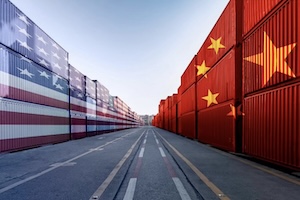
General Motors (GM) has instructed thousands of its suppliers to phase out sourcing parts and materials from China by 2027. The exit strategy began in early 2024, with the directive gaining momentum in spring of this year, 2025. This directive is part of GM’s broader strategy to enhance supply chain resiliency and reduce exposure to geopolitical risks, particularly amid escalating, or let’s just say, continuously fluctuating, U.S.–China trade tensions.

For decades, the U.S. dollar has ruled the world. Whether a Brazilian farmer sells soybeans to China or an Indian company buys oil from the Middle East, chances are the transaction runs through greenbacks. Nearly 80 percent of global trade is still denominated in dollars—even when neither the buyer nor the seller is American.