
News Articles

Section 232 Iron

Section 232 and Iron: What CBP’s New Guidance Means for Your Imports – The Difference Between Steel and Iron Has Never Mattered More

We are operating in one of the most volatile trade environments in recent memory. Tariff policy is shifting faster than most compliance programs can absorb. In that context, CBP’s March 15 guidance on Section 232 content value is not just a technical update. It brings meaningful clarity and importers who move quickly may find real money on the table.

Read More »
301 Tariffs

Section 301 Tariffs: A New Phase in U.S. Trade Policy

The resurgence of Section 301 tariff investigations marks a pivotal shift in U.S. trade policy. Following the Supreme Court’s invalidation of tariffs imposed under the International Emergency Economic Powers Act (IEEPA), the Office of the U.S. Trade Representative (USTR) has turned to Section 301 of the Trade Act of 1974 as a more durable legal pathway to reimpose and potentially expand tariff measures.

Read More »
AI Legislation

AI Legislative Framework Proposed by the White House

On March 20, 2026, the Trump Administration announced that it, “is committed to winning the AI race to usher in a new era of human flourishing, economic competitiveness, and national security for the American people.“ The White House issued a new comprehensive national legislative framework that addresses six key objectives.

Read More »
IEEPA

Supreme Court Clarifies Separation of Powers in IEEPA Tariffs Decision

In the final analysis, this case stands as one of the most important separation of powers decisions in the economic domain in U.S. history. It clarifies that tariffs are a form of taxation reserved to Congress, embeds the major questions doctrine in trade law, and reasserts the structural boundary between legislative and executive authority.

Read More »
Canada Carney

Goodbye USA – Canadian Prime Minister Mark Carney’s MiddlePowers Playbook is Officially in Play, Part 2

One of my recently published articles covered the World Economic Forum Davos speech by Canadian Prime Minister Mark Carney, where he summoned the middle powers of the earth to unite against the US forces who are demanding that they take a knee and capitulate, per Governor Newsom who was in attendance handing out knee pads. (Really) Well, to say the least, that’s not happening by even the longest stretch of anyone’s imagination.

Read More »
CTPAT Investigation

Keeping the Chain Secure: A Deep Dive into the Latest CTPAT Investigation

The global supply chain is the backbone of the U.S. economy, moving millions of tons of cargo daily. To keep things running smoothly and safely, U.S. Customs and Border Protection (CBP) place a significant reliance on the Customs Trade Partnership Against Terrorism (CTPAT). This voluntary program trades “gold star” benefits—like fewer inspections, business resumption priority, and faster border crossings—for a company’s commitment to high-level security.


Read More »
Statute of Limitations

CBP Statute of Limitations Waivers – Overview of Issues and Operation

Many trade practitioners that have had experience with a CBP prior disclosure or penalty action have encountered a request by CBP to execute a Statute of Limitations (SOL) waiver. These are usually accompanied by a request for the importer to provide a corporate resolution or the equivalent evidencing the authority of the SOL waiver signatory to sign the waiver on behalf of the importer / company.

Read More »
Mexico

Contratos Celebrados por Importadores Mexicanos (Su Relevancia en la Materialidad de las Operaciones Aduaneras y de Comercio Exterior)

El marco jurídico mexicano en materia aduanera y de comercio exterior ha evolucionado hacia un modelo de cumplimiento más estricto y controlado.  Las autoridades ya no solo exigen que los importadores identifiquen cual es la mercancía objeto de la importación, sino también que acrediten bajo que términos y condiciones se realiza la operación de comercio exterior.

Read More »
Mercosur

Mercosur Update

Let’s rewind to December 6, 2024. A deal more than 25 years in the making, covering over 700 million people and a combined GDP approaching $22 trillion, became realized. Since then, the agreement has made notable institutional progress while encountering renewed legal and political resistance that will shape its path to implementation. What’s happened recently?

Read More »
BRICS

BRICS: An Update and a Challenge

Has BRICS finally produced an alternative to the “petrodollar” after twenty years? And does it live up to the hype? Depending on where you look online, key details are being left out. So, let’s slow down and review what’s actually happening.

Read More »
EU and India

After Two Decades of Failing to Come to an Agreement “The Mother of All Deals” is Done – Kudos to India and the EU

As of 1/27/2026, India and the EU have finalized a free trade agreement described by both sides as the “mother of all deals” that slashes tariffs, opens markets, and creates a combined economic region of roughly two billion people. This FTA stands as one of the most consequential global trade realignments in years, driven in part by U.S. tariff pressure and a shift in strategy toward diversifying one’s supply chains.

Read More »
Davos Canada

Hot Topics in International Trade – The Davos Speech by Canadian Prime Minister Mark Carney The Middle Powers Playbook and a Global Trade Realignment in the Making

For whatever reason, if you missed the spectacle created by President Trump on the world stage recently in Davos, Switzerland at the World Economic Forum, you really need to pay close attention now to the fall out. Top business executives in global economies were watching and probably also wondering just who the hell was going to stand-up to the U.S. pressure campaign, and that’s where Canadian Prime Minister Mark Carney stepped up to the mic and delivered a speech that sent shockwaves across continents.

Read More »
Global Chaos

Global Chaos and Global Trade – The New World Disorder and the Ensuing Economic Carnage

On any given morning so far in 2026, looking around the globe, one could easily surmise that chaos rules, and the world of trade as result is on fire. The global landscape is filled with trade barriers, tariffs, sanctions, and export controls, from microchips and dairy to lumber, steel and aluminum. We have seen where geopolitical disputes often escalate into trade wars, where countries impose tariffs or targeted restrictions on each other’s goods, but an actual invasion, that’s on a totally different level regarding how it affects trade and global economies.

Read More »
usmca

The Upcoming USMCA/CUSMA/T-MEC Review The Options are: A Renegotiation, A Few Revisions, or a Formal Exit

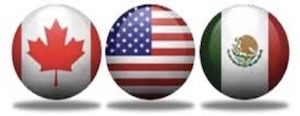
The exit of a country, such as the U.S., from the USMCA, well, that’s just crazy, right? Afterall, it’s a powerhouse of a trade agreement between the three nations. According to the U.S. International Trade Administration, the United States conducts over $1.3 trillion in annual trade with Mexico and Canada under the USMCA framework and supports roughly 17 million jobs across North America.

Read More »
IEEPA Refund

Potential IEEPA Refunds Guidance

The legality of the Fentanyl IEEPA tariffs and the Reciprocal IEEPA tariffs is currently pending in the Supreme Court. A decision is expected in January, although it could come sooner, though the Court may not directly address refund mechanics. Instead, it could remand the issue to the Court of International Trade (CIT), which would delay guidance for several months.

Read More »
BRICS

BRICS and the Drive Towards De-Dollarization: Has It Stalled?

Could BRICS break the dollar’s grip? The answer is coming into sharper focus, and it’s more complicated than either the optimists or skeptics predicted. Since our previous analysis, BRICS has made concrete moves toward de-dollarization while simultaneously confronting harsh economic and political realities. The gap between ambition and achievement has never been clearer.

Read More »
tariffs

Taxing Imports: Tracing the Role of Tariffs in U.S. Economic Policy

In the Chinese zodiac calendar, 2025 is the year of the snake. The snake is said to represent wisdom and strategy. As it occasionally sheds its skin, it is also said to represent a change or an inflection point. Whether American trade policy in the year of the snake exemplifies wisdom and strategy depends on one’s political perspective. Whether it exemplifies a major transformation and inflection point is unquestionable.

Read More »