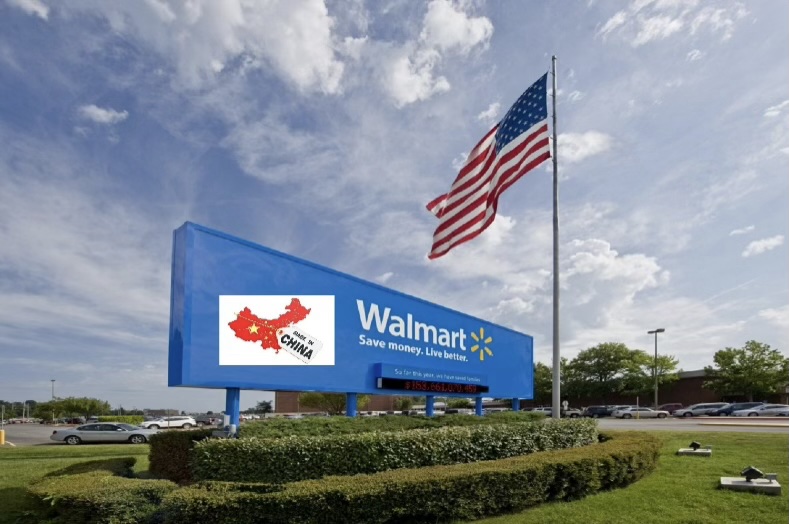
It’s also been interesting to say the least how trade in general has responded since 2018 and the introduction of Section 301 tariffs, but to see the full view of ramifications from these same tariffs on US businesses sourcing in China, it’s always best, in my opinion, to take a look at who gets hit the hardest, which is the SMEs of course, but also the how the industry giants are affected. I previously wrote about GM’s strategy to decouple from China by 2027, https://www.braumillerlaw.com/the-automotive-industry-chinas-semi-grip-on-supply-chains-and-general-motors-2027-exit-strategy-for-suppliers-is-a-clean-break-even-possible/but what about Walmart? They are the absolute retail titan of the US with incredibly deep roots in China. Decoupling here is a very tough nut to crack given the fact that the China to Walmart supply chain lifelines of various products have been developed over decades, as Walmart actually started sourcing in China back in the late 70’s, and it’s this China based sourcing that has kept Walmart’s pricing competitive over the years. Walmart is by far the largest retailer in the US with sales of $462B (2025), and Worldwide retail sales of $681B (2025). 84% of Walmart’s global sales come from the U.S. via over 4600 brickandmortar locations. So where does a good majority of that product come from that ends up in roughly 40 million households in the US? Well class, everyone say it with me in unison now, China of course, the sourcing capital of the world. The best available 2025 data show about 60% of Walmart’s U.S. retail imports came from China in 2025, down from about 80% roughly 7 years ago. Obviously, as previously mentioned, when the first Trump Administration slapped the Section 301 tariffs on Chinese imports, it was the catalyst for diversification in global sourcing. Given the newly announced Section 301 investigations of 60 countries (With China as a focal point again) regarding forced labor and structural excess capacity, it’s going to get even harder to get product into the U.S. without issues. Accordingly, Walmart has once again accelerated efforts to diversify, but it is much easier said than done. The scale of operations is 400,000+ SKUs, and 4,000+ suppliers, an absolute monster of connectivity.
A few years ago, I wrote in a previous article about Walmart (one of my favorite subjects) sourcing agents who were landing in Lear Jets in multiple Chinese cities and had a reception of red carpets and rose petals thrown at their feet, based on the sheer volume of purchasing power of course. Well, that’s a pretty cool vision of power, but not really true, as Walmart actually has offices in each of the major Chinese cities that they source from, which makes total sense. Kind of boring, but practical. Oh well, but if they were hypothetically flying Lear Jets into China for sourcing runs, they would concentrate their efforts in the same manufacturing and export clusters that drive most U.S. retail supply chains — Shenzhen, Guangzhou, Dongguan, Shanghai, Ningbo, Suzhou, and Yiwu — because that’s where the supplier density, export infrastructure, and of course in reality where Walmart’s own globalsourcing offices are located. Publicly available data (because corporate won’t respond to my emails) points to roughly 500–1,000 employees in Walmart Global Sourcing. That aligns with Walmart’s footprint across 22 sourcing countries. The following are the cities where Walmart’s global sourcing teams, vendor bases, and logistics partners are most active and are consistent with China’s highestvolume export clusters. Shenzhen (Guangdong) sourcing is electronics, small appliances, smart devices, and accessories. Walmart opened its first China stores here and maintains deep supplier networks with a heavy presence of Walmart Global Sourcing staff and QC teams. Guangzhou & Dongguan sourcing is apparel, home goods, toys, plastics, and furniture, which is due in part to a massive supplier density and proximity to export ports. Shanghai (Yangtze River Delta), sourcing is higherend electronics appliances and tools. Walmart Global Sourcing has major operations in Shanghai. Suzhou (Jiangsu), is where they source precision manufacturing, tools and home appliances. Ningbo (Zhejiang) is one of China’s largest export ports with a heavy concentration of Walmartaligned suppliers in home goods, kitchenware, and seasonal items, and Yiwu (Zhejiang) rounding out the base with small commodities, lowcost consumer goods, and accessories. This is a major hub for Walmart’s “everyday low price” categories, and also the largest by volume port in the world. So, it begs the question(s), in what categories does Walmart show the most movement of product sourcing out of China and just where is it going? First and foremost, it’s apparel, footwear and textiles moving to Vietnam. Why Vietnam? Well, Vietnam has strong garment clusters, lower tariffs, and a well-developed export infrastructure, which allows Walmart to expand with direct shipping from Vietnam to its fulfillment centers. As mentioned with apparel being the lead dog in the sled out of China, the reason behind it is the fact that apparel is the easiest category to relocate due to it being labor intensive, low cost in tooling, and Vietnam already having a great deal of experience serving other giants like Target, and The Gap.
Regarding home goods, kitchenware, ceramics and additional textiles, the go-to here is India. It makes sense as India has a huge textile and home goods base, its labor costs are more than competitive, the government has incentives for export manufacturing, and Walmart’s Flipkart ecosystem aids in local supplier development. India is ideal for categories where craftsmanship, textiles, and metalwork dominate, and where China’s cost advantage has diminished. India now accounts for more than 25% of Walmart’s import sourcing, which is up from just 2% in 2018. This increase came almost entirely at the expense of China, whose share has fallen from 80% to 60% over the same period.
Furniture, plastics, seasonal goods, and appliances are heading to Mexico. Why Mexico? Think about it, nearshoring reduces lead times (critical for OTIF-on time in full), and of course there are the USMCA tariff advantages. Besides, Walmart already has deep supplier networks in northern Mexico, and lower logistics risk vs. transPacific shipping is in place. Categories shifting arereadytoassemble furniture (like Ikea-ugh!), plastic household goods, seasonal décor, and small appliances (select SKUs). Obviously, there is the benefit in freight savings from nearshoring, as well as faster replenishment. This is huge, and includes toys, as 80% of the toys sold in the US come from China, but C est la vie toys are being split between Vietnam & Mexico. Why? Well, toys are highly tariffexposed and easy to relocate, and Vietnam has strong toy clusters while Mexico offers nearshore speed. Currently, China still dominates, but Walmart is actively diversifying due to tariff volatility with no end in sight.
Considering small appliances & lowcomplexity electronics, these commodities are also going to Vietnam & Mexico. Why? Same reason, tariff pressure on Chinese electronics. Walmart’s logistics expansion into Vietnam supports appliance flows, and Mexico can certainly handle simple assembly. Just look at over 6500 IMMEX scattered throughout Mexico and their industrial capability performed at a great labor rate. Additional categories leaving the mainland are fans, kettles, rice cookers, basic audio devices, and LED lighting. Highcomplexity electronics (phones, tablets, smart devices) remain Chinacentric for now and for the foreseeable future. Actually, I do not see this changing in the long run as China has recently made tremendous strides in advanced chip manufacturing.
Let’s segue to what’s not moving (Yet), because they are heavily Chinadependent due to ecosystem depth are advanced electronics (Shenzhen/Dongguan), lithiumion battery products, precision tools (Suzhou/Shanghai), and highvolume plastics (Pearl River Delta) However, Walmart is probing alternatives, but the supply chain depth is still very much in favor of China.
One could venture to say, and one might, with only slight hesitation, that the discussion within the Walmart corporate walls in Bentonville Arkansas regarding the most viable alternative countries and product shifts that they are actively cultivating include: Shenzhen (Electronics, Smart Devices, Small Appliances)
Primary replacements:
- Vietnam — small appliances, basic electronics assembly
- Malaysia — PCB assembly, power supplies, some consumer electronics
- Thailand — midtier electronics, whitelabel appliances
- Mexico — simple assembly + nearshore final assembly
- India — phones, chargers, accessories (still scaling)
Why this works is mainly due to the fact that Vietnam and Malaysia can absorb lowcomplexity electronics, Mexico reduces lead times for appliances, and India is scaling rapidly under PLI incentives. What doesn’t work is that no country can replicate Shenzhen’s full-stack ecosystem inclusive of chips, boards, plastics, firmware, and packaging. Again, of course, for now, highcomplexity electronics remain Chinaanchored. I’m pretty sure India is on deck.
2. Guangzhou / Foshan (Apparel, Footwear, Textiles)
Primary replacements:
- Vietnam — apparel, footwear, cutandsew
- Bangladesh — ultralowcost apparel
- India — textiles, home goods
- Indonesia — footwear, athleisure
- Cambodia — basic garments
What works here, as previously mentioned, is that apparel is the easiest category to relocate and Vietnam and Bangladesh already supply Walmart at scale. What doesn’t work is that China still dominates synthetic fabrics and highspeed production. Let’s face it here, China is the largest exporter of apparel in the world controlling about 30%. That’s massive in scale.
3. Dongguan (Toys, Plastics, LowCost Consumer Goods)
Primary replacements:
- Vietnam — plastic toys, plush toys
- Mexico — nearshore toy assembly, seasonal toys
- Indonesia — plastics, molded goods
- India — simple toys, wooden toys
What works here as well is that toys are tariffexposed and easy to shift, and Vietnam has positioned itself to be extremely competitive when it comes to the toy clusters. What doesn’t work is that Dongguan’s moldmaking ecosystem is unmatched, (meaning nobody can do what they do) and complex toys (electronics + plastics) still rely on China who has a long history of domination in this category.
4. Ningbo (Home Goods, Kitchenware, Seasonal Items)
Primary replacements:
- India — stainless steel kitchenware, ceramics, textiles
- Turkey — glassware, ceramics
- Mexico — seasonal décor, plastics
- Vietnam — kitchen tools, storage goods
What works is that India is a natural replacement for metalware and textiles, and Mexico wins on bulky seasonal items. What doesn’t work is that Ningbo’s port and supplier density is hard to replicate. The Ningbo port is absolutely essential and top of the chain to China’s economy.
5. Yiwu (Small Commodities, Accessories, UltraLowCost SKUs)
Primary replacements:
- India — small hardware, accessories
- Vietnam — stationery, small plastics
- Bangladesh — lowcost textiles
- Mexico — limited (labor cost mismatch)
What works here is that India and Vietnam can easily absorb some of these lower end categories.
What doesn’t work is that Yiwu is almost irreplaceable as no other country has a comparable “small commodities universe” with millions of microfactories. It’s a powerhouse in this respect.
6. Suzhou (Tools, Hardware, Precision Goods)
Primary replacements:
- Mexico — basic tools, metal goods
- India — hand tools, castings
- Turkey — metal fabrication
- Vietnam — limited (not precisiongrade)
What works of course is that Mexico can handle simple tools and India can scale midtier metalwork. What doesn’t work is that precision machining and QC culture in Suzhou is extremely hard to replicate. Have you ever given a Chinese origin product less than a five-star review on Amazon? If so, then you would know, it’s a crisis to the manufacturer, and they will do whatever it takes to make amends and get you to change your review to a favorable one.
Shanghai (HigherEnd Appliances, Tools, Consumer Durables)
Primary replacements:
- Mexico — appliances, nearshore assembly
- Thailand — midrange appliances
- Malaysia — electronics-heavy appliances
- Vietnam — partial assembly
What works is that Mexico is the strongest alternative for appliances, and Southeast Asia can handle midtier durables. What doesn’t work is that China’s integrated supply chain for motors, compressors, and electronics remains absolutely dominant. It makes me want to throw in the fact that China supplies 70% of the world’s batteries, and of course 90% of the globe’s rare earth minerals. The power in just these two exports is mind numbing.
Based on the most recent publicly available data, (because Walmart corporate still won’t respond to my emails) Walmart has shifted roughly 20–25% of its import volume away from China over the 2018–2026 period — primarily toward India and Mexico. As previously mentioned, India is Walmart’s fastestgrowing sourcing base. Let’s restate the obvious, the driving force behind the product shifts away from China is grounded in the tariff volatility, although recently the Supreme Court’s IEEPA ruling and Section 122 tariffs being deemed unlawful by the Court of International Trade, have provided somewhat of a reprieve, as well as refunds. Walmart stands to recover $10.5M in IEEPA refunds. Refunds like this however may be the catalyst (let’s not kid ourselves-they are) for the Trump administration to get really creative within the new Section 301 investigations. Many issues will be found, the money will follow from penalties, and I am sure quotas and bonuses will be met and paid for within CBP. Afterall, IEEPA refunds is around $166B total once claimed in full, and Section 122 was temporary to begin with at only 150 days legally allowable max. (Shot down by the CIT, but currently held up by appeal in court)
With all of the turmoil, and funds at stake, allow me a slight digression, but this is interesting and somewhat relevant to the cause of saving one’s profitability. While for China the gates of hell were opened when Section 301 was announced back in 2018, you would think that the Walmart lobbyists would be exhausted by now, but still pretty damn busy, and under a great deal of pressure. So, how many lobbyists does Walmart have? Well, this particular trade war between China and the US has an internal army at work in D.C. 24/7. OpenSecrets, a Washington D.C. based, nonpartisan, nonprofit who acts as the leading research authority on money in US politics, says as of 2024 Walmart reported 71 lobbyists working on its behalf in Washington, D.C. 52 of the 71 were “revolvers” who are individuals who previously worked in government before lobbying. A 2025 profile shows Walmart continuing to spend heavily on federal lobbying — $4.6 million in the first half of 2025, which I am going to assume $10 million total for 2025, and in the first five months of 2026 $5.5 million. Hey, Bentonville, correct me here if I am wrong. Given historical patterns in the mix, to accommodate the spending on dinner and drinks, Walmart typically employs 60–80 lobbyists annually. This places Walmart among the more heavily represented corporations on K Street. (The Wall Street of lobbying firms in D.C.) It begs the question, how well are they doing? That’s another question for the corporate peeps in Bentonville.
Now back to the exodus from China. What everything I have mentioned means, as far as diversification, is that currently established operations will primarily share in the load flowing out of China. That being said, here is the overall brick and mortar operations picture. Walmart operates 10,500+ stores and clubs worldwide. What this means in practice is that Walmart’s global footprint is concentrated in:
- United States (largest market) Walmart operates roughly 4,600 Walmart stores in the U.S., plus about 600 Sam’s Club locations.
- Mexico (3,154 stores)
- Central America (925)
- Canada (402–403)
- Chile (395)
- China (366–370)
- South Africa & Massmart region (~411)
To support this, Walmart Global Sourcing total headcount (all roles)
A major employeedirectory dataset shows:
- 418 employees in Asia
- 181 in North America
- 12 in Europe
- 5 in South America
- 1 in Africa
- 1 in Oceania
This totals 618 employees in the sourcing organization captured by that dataset if you wish to take a stab at being specific. This aligns with other corporate directories that place Walmart Global Sourcing in the 501–1,000 employee range. I think this is a solid foundation for a huge undertaking of moving the 4000+SKU’s out of China, even though some will inevitably need to stay behind. Afterall, what could possibly happen regarding the trade relationship with China that hasn’t already happened? 250% tariffs?
In a much bigger picture, and even with Walmart involved there is one, is that there has been a major factory exodus from China that began in 2018 due to U.S. tariffs and rising costs. Vietnam, Thailand, and Southeast Asia have absorbed much of the shift as entire industries like furniture, electronics assembly, packaging, and components have partially relocated. The number of factories relocating is in the thousands. I can assure you though, from where I sit on the legal side of the factory movement, much of the sourcing remained from China, and that’s a big “whoops”, as in many instances substantial transformation of the end product never took place, and therefore, that particular product is still country of origin China, and subject to the tariffs in place. In many cases it was true, you could take the factory out of China, but you couldn’t take China out of the factory. There was a time in the early stages of Section 301 where we could stand in front of the Commerce Department in D.C. on behalf of our clients and make the pitch to prove that nowhere else on God’s primarily blue earth could our client source from anywhere on the planet but China and keep the business running. We actually got pretty damn good at the exemptions process and were batting about 750. (The norm was 300) Well, those exemptions are no longer in place for the most part exclusive of some carve outs per the Trump administration. It goes with the new territory regarding heightened enforcement and scouring the trade landscape for replacement revenue, given the recent court rulings striking down the tariffs.
Let’s wrap things up. Will Walmart ever successfully depart 100% from China sourcing? Doubtful. Will things change for the better in the trade relationship between the US and China in the near future? Well, at the time of this writing, post Trump-Xi summit, things do not seem to have turned out the way the Trump administration had planned because the relationship seems to remain tentative at best. Why? Well, Xi pretty much laid down the gauntlet on the potential interference from the U.S. regarding the impending reunification of Taiwan which could bring about WW3. Obviously, the war in Iran, and just what the hell to do with the Strait of Hormuz is still at the top of the list and President Trump is once again threatening to “wipe out everything” if Iran doesn’t get its act together soon. Soon being two weeks? Well, that would be my guess. Yes, China did supposedly agree to purchase about 200 Boeing jets, $17 billion per year in U.S. agricultural imports through 2028, and provided the US with renewed access for U.S. beef and poultry restoring listings for over 400 US facilities. Soybeans were on the list but not tonnage specific, and some microchips were supposedly sold via Nvidia, but that all remains to be seen. Worth noting on this mission, the US administration was traveling with a group of CEOs from companies like Nvidia, Apple, Meta, Exxon, Boeing, Qualcomm, Micron, Nvidia, Illumina, Coherent, Blackrock, Blackstone, Citigroup, Visa, Mastercard, Goldman Sachs, GE Aerospace, and Cargill, but thus far a few other deals are just business conversation as concrete transactions have yet to materialize. In the end, this trip was an opportunity to try to get the focus back on a healthy U.S.–China relationship regarding technology competition inclusive of semiconductors and AI, energy security, aviation and aerospace, financial markets and capital controls, but instead, it was a well-planned and staged proclamation by Xi, that we do not wish to revisit Thucydides Trap which originates from 2500 years ago concerning the history of the Peloponnesian War (Athens vs. Sparta). The message here is when a rising power grows strong enough to challenge the dominant power, fear, miscalculation, and escalating rivalry can push both sides into conflict — even if neither wants war. Throughout the summit, Xi appeared to be well-rehearsed and calculated as Trump was attempting to pour on the charm. Despite the positive tone, there were no agreements on semiconductor restrictions, industrial policy, export controls, broader tariff rollback, technology transfer rules or major market access reforms. It’s all up in the air for now, just like the reunification of Taiwan. In closing, an honorable mention from the summit is that two brand new US-China economic institutions have been established. The U.S.–China Board of Trade that manages bilateral trade in non-sensitive goods, and the U.S.–China Board of Investment, a government-to-government forum for investment issues. Nobody has been appointed at this time to either board. Nobody.
One final note, I promise….. according to Bloomberg reporting, and cited in multiple outlets, China proposed a $1 trillion investment in the U.S. economy with the condition that the U.S. would need to lift restrictions that prevent Chinese companies from making deals in the United States. This was originally part of 2025 trade negotiations with Treasury Secretary Scott Bessent and was never finalized, accepted, or converted into a binding agreement. Too much fear of Chinese ownership? My guess. I’ll know more in about two weeks…