By Eiyack-Cacho Ayala, Associate Attorney, Braumiller Law Group
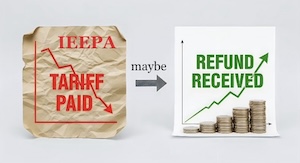
When the U.S. Supreme Court invalidated certain tariffs imposed under the International Emergency Economic Powers Act (IEEPA) in Learning Resources, Inc. v. Trump, it did more than reshape trade policy. The decision triggered a complex series of questions regarding tariff refunds, consumer rights, and corporate liability – questions whose effects continue to be felt far beyond the trade community, reaching businesses and households across the US.
The Court’s ruling struck down tariffs that had generated approximately $166 billion in import duties, creating immediate uncertainty regarding how previously collected duties would be refunded and who should ultimately benefit from those refunds. In his dissent, Justice Kavanaugh warned that requiring the government to return billions of dollars in duties already paid by importers, particularly where those costs may have been passed through to distributors, retailers, and consumers, was likely to be a “mess.”
That prediction increasingly appears to be coming true.
As courts, U.S. Customs and Border Protection (CBP), and the administration continue to dispute the scope and administration of potential refunds, businesses across multiple industries are facing growing scrutiny from consumers, regulators, shareholders, and supply-chain partners over who should ultimately benefit from the IEEPA refunds.
Refunds Create New Litigation Risks
Recent reports indicate that approximately $85 billion in potential and certified refunds have already been accepted for processing by CBP. As those refunds move through the system, plaintiffs’ attorneys are pursuing a new theory: companies that increased prices due to tariffs should not be permitted to retain both the higher prices paid by consumers and the refunded duties returned by the government.
Several class action lawsuits have already been filed against retailers, manufacturers, and logistics providers. While the facts differ from case to case, the central allegation remains largely the same: consumers allegedly absorbed tariff-related costs through higher prices, and companies may now improperly receive refunds for those same costs.
Among the most closely watched cases are actions against IKEA, Nintendo, UPS, and Fabletics. Plaintiffs generally seek compensatory damages, statutory remedies, and court orders requiring companies to establish mechanisms for returning refunded amounts to consumers. Other companies such as DHL, FedEx and UPS have already voluntarily announced or established “secondary refund” systems to pass the refunds received to consumers, possibly in an effort to avoid litigation.
These lawsuits reflect a significant evolution in customs-related disputes. Historically, tariff litigation was largely confined to importers, customs authorities, and trade practitioners. Today, customs policy increasingly intersects with consumer protection law, placing trade issues squarely in the public spotlight.
The Legal Theories Behind the Claims
At their core, these cases ask courts to resolve the same fundamental question: Who should benefit from tariff refunds once tariff costs have already been passed through the supply chain?
The most prominent theory advanced by plaintiffs is unjust enrichment. Plaintiffs argue that companies should not retain both tariff-driven price increases collected from consumers and tariff refunds subsequently returned by the government. Courts will likely be asked to determine whether retaining both forms of compensation constitutes an inequitable windfall.
Many complaints also invoke state consumer protection statutes, alleging that companies misrepresented the necessity or permanence of tariff-related price increases. Public statements made during earnings calls, shareholder communications, advertisements, and other corporate disclosures are increasingly being cited as evidence linking higher prices directly to tariffs.
In cases involving explicit tariff surcharges or shipping fees, plaintiffs have also asserted breach of contract claims. Others seek declaratory and injunctive relief requiring companies to establish refund programs or distribute recovered tariff proceeds.
State Attorneys General May Follow
As the debate over who should benefit from tariff refunds expands, attention is increasingly shifting from private plaintiffs to state regulators.
State attorneys general are likely to closely examine whether businesses that passed tariff costs on to consumers should be permitted to retain tariff refunds. Broad unfair and deceptive acts and practices (UDAP) statutes provide regulators with another avenue to challenge business practices surrounding tariff-related pricing and refunds.
These statutes often provide regulators with significant enforcement flexibility and, in some jurisdictions, do not require proof that consumers actually relied on the company’s announcements. As a result, investigations can begin with a single consumer complaint and quickly expand into subpoenas, civil investigative demands, and extensive document requests. As refunds begin flowing through the system, regulators may increasingly scrutinize whether businesses are receiving a windfall at the expense of consumers.
Beyond Consumers: Supply Chain and Shareholder Exposure
The refund controversy may also create disputes between businesses themselves as importers, distributors, retailers, and logistics providers frequently negotiated tariff-related pricing arrangements while the IEEPA tariffs were in effect. In many cases, contracts did not clearly address how future tariff refunds would be allocated. As refunds are issued, parties may find themselves litigating surcharge provisions, cost-sharing arrangements, and pricing adjustment clauses.
Public companies face an additional layer of exposure. Some commentators have suggested that shareholder derivative actions could arise if companies failed to preserve refund claims, inadequately disclosed potential recoveries, or otherwise failed to protect corporate assets associated with tariff refunds.
The Refund Process Remains in Flux
While consumer and commercial litigation continues to expand, the refund process itself remains subject to significant legal uncertainty.
On June 2, the United States appealed the Court of International Trade’s order directing CBP to issue refunds of duties collected under the IEEPA tariff regime, challenging the court’s requirement that refunds be issued even for finally liquidated entries where importers had not filed their own lawsuits. The government also petitioned the U.S. Court of Appeals for the Federal Circuit to block a trade court order requiring CBP Commissioner Rodney Scott to testify regarding the agency’s administration of the refund process.
The administration has argued that the trade court exceeded its authority by issuing nationwide relief and has challenged efforts to compel testimony from senior CBP leadership, citing separation-of-powers concerns and longstanding precedent limiting compelled testimony from high-ranking executive branch officials.
These developments underscore that the mechanics of the refund process remain actively contested. As appeals proceed, businesses may face continued uncertainty regarding the timing, scope, and administration of potential refunds.
Looking Ahead
Several critical legal questions remain unresolved. Who legally owns a tariff refund – the importer that paid the duty or the consumers who may have ultimately borne the economic burden? Can consumers establish a sufficient connection between tariff costs and the prices they paid? To what extent do federal trade laws preempt state consumer protection claims?
At the same time, Congress continues to consider consumer rebate proposals tied to tariff-related inflation, creating the possibility of overlapping judicial and legislative remedies.
For businesses operating in tariff-affected sectors, the lesson is increasingly clear: customs compliance can no longer be viewed solely as a trade issue. The intersection of tariff refunds, consumer protection law, regulatory enforcement, corporate governance, and supply-chain contracting has quickly transformed what was once a niche customs issue into a multifaceted legal challenge.
Before courts can fully address who should benefit from tariff refunds, appellate courts may first need to determine the scope of the government’s refund obligations and the extent of the Court of International Trade’s authority to supervise that process.
Read more articles by this author: https://www.braumillerlaw.com/author/eiyack/