
A Day in the Life of a Trade Compliance Manager: A Corporate Parable
A fly on the wall at an executive retreat for Acme Super Duper Widget Company overhears the following conversation between Pete, the CFO, and Saira, the General Counsel.

A fly on the wall at an executive retreat for Acme Super Duper Widget Company overhears the following conversation between Pete, the CFO, and Saira, the General Counsel.

The CTPAT portal has been a work in progress for a number of years with the latest portal update (3.0) launched at the end of 2023. Let’s take a few minutes to explore a few strategies for best outcomes while avoiding common challenges and the SCSS response request for “more information”.

Those who cannot remember the past are condemned to repeat it.” – George Santayana. As an example of this I present to you the Smoot-Hawley Tariff Act of 1930. If you are not familiar with this, it is worth taking a moment to research.

Recently, President Biden signed a foreign military support bill (H.R. 815) into law, which also encompassed the 21st Century Peace Through Strength Act (the Act), a legislative proposal introduced in the House containing various U.S. sanctions-related measures. These sanctions measures extended the statute of limitations (“SOL”) from five to ten years for civil and criminal violations of sanctions programs administered by the U.S. Treasury Department’s Office of Foreign Assets Control (“OFAC”).

The new world order apparently has some merit as more than 30 nations have reportedly submitted applications to join the BRICS alliance wanting to reduce reliance on the US dollar. This wave of applications is a testament to the trust in the BRICS alliance as a viable option to a traditional economic structure. The BRICS alliance has broad shoulders and is representative of considerable economic growth.

On May 14, 2024, the United States Trade Representative (USTR) released its Final Report relating to the four-year review of actions taken in the Section 301 investigation. Within the Report, the USTR confirmed that it intends to take actions to raise tariffs on specific products as a result of the comprehensive review.

Canada has long enjoyed International Traffic in Arms Regulations (ITAR) license exemptions and minimal controls for items subject to the Export Administration Regulations (EAR). What about some of our other friends, such as Australia and United Kingdom? There are ITAR license exemptions for these countries in Parts 126.16 and 126.17 of the ITAR.

The United States Trade Representative (USTR) recently released a list of Section 301 exclusions that would be extended through May 31, 2025. Within the Notice, the USTR explained that extending these exclusions will support efforts to shift sourcing out of China, or provide additional time where, despite efforts to source products from alternative sources, availability of the product outside of China remains limited.

China’s foreign direct investment (FDI) in Mexico has seen substantial growth in recent years, reflecting a strategic alignment with global economic shifts and regional trade dynamics. This trend positions China as one of the fastest-growing sources of foreign investment in Mexico, with the majority of investments flowing into the manufacturing sector.

Digital assets, including blockchain and cryptocurrency protocols and companies, have been in a defensive posture for much of 2022, 2023 and 2024. The collapse of crypto exchange FTX and numerous enforcement actions taken by the Securities Exchange Commission (SEC) and Commodities Futures Trading Commission (CFTC) have forced the sector to retrench and upgrade their abilities to meet the higher standards of securities laws.

Historically, trade agreements have focused on reducing barriers to trade—such as tariffs and quotas—while encouraging economic integration and growth. Environmental protection was often considered a separate issue, addressed primarily through national regulations or multilateral environmental agreements like the Paris Agreement. However, recent developments suggest that trade and environmental concerns are converging, with many new trade agreements incorporating specific environmental provisions.

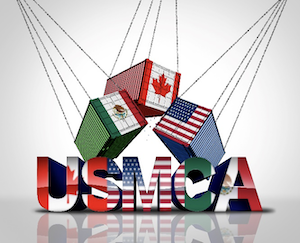
This is the first of a three-part series about the USMCA joint review process, focusing on China, Mexico, and competing visions of a “worker-centered” trade policy. Part one introduces the USMCA joint review process and explores how US trade policy would likely operate during Trump’s second term. Part two outlines some of the major trade issues that will be on the table during joint review, focusing on the Mexico-US relationship, and anticipates Harris’s likely approach to trade policy. Part three offers a critique of the worker-centered trade policy developed under the Biden administration, presents an alternative, and suggests new avenues for multi-stakeholder participation that Harris’s approach might create.

The US, Canada, and Finland are launching a joint partnership to build more ice-breaking ships to compete with China and Russia in Arctic. Sad but true, here we go again. Whether it’s the South China sea, or even the moon, there will be territorial disputes to challenge ownership where no ownership should actually exist. The pact aims to produce a fleet of ice-breaking ships to display a posture of power in the polar regions and enforce international norms and treaties.

A product has a country of origin of China, is not subject to China 301 duties and is eligible for USMCA benefits when imported from Canada – Whaaat!?

In the complex world of commercial international trade, contracts serve as the foundation for successful transactions. A well-prepared contract review checklist provides a basis for lawyers to ensure that all necessary terms and conditions are covered, protecting all parties involved. This article outlines the essential components of a contract review checklist related to goods in international trade. The goal is to provide a structured approach to reviewing and drafting contracts, beyond the basics of INCOTERMS.

Imagine a world where five powerhouse nations are redefining the global economic landscape. BRICS—an acronym for Brazil, Russia, India, China, and South Africa—is not just a coalition of emerging markets; it is a formidable alliance shaping the future of global finance and investment. You can read about the coalition’s attempt to unseat the US dollar in our previous newsletter.

Texas isn’t just celebrated for its breathtaking landscapes and rich history—it’s a dynamic powerhouse in international and interstate trade. As the second-largest state in the U.S., Texas capitalizes on its strategic location, diverse economy, and vast infrastructure to fuel an extraordinary flow of goods and services. If Texas was a country, it would be ranked as the eighth- largest economy in the world, ahead of both Canada and Russia.

On July 10, 2024, the President issued two Presidential Proclamations related to the imposition of Section 232 duties on certain steel and aluminum products from Mexico. The first establishes a “melt and pour” requirement for imports of steel articles that are products of Mexico and will increase the section 232 duty rate for imports of steel articles and derivative steel articles that are products of Mexico that are melted and poured in a country other than Mexico, Canada, or the United States.

The Customs-Trade Partnership Against Terrorism (CTPAT) program can offer a fast thoroughfare for international trade. But navigating the annual security audits that ensure CTPAT compliance can feel like a maze. Don’t worry, we’ve got you covered! Let’s explore some common hurdles faced during CTPAT security audits, along with practical tips to simplify the process.

One of the most anticipated decisions of the Supreme Court’s recent term was Loper Bright Enterprises v. Raimondo. While the specific underlying dispute in Loper Bright isn’t relevant to the trade community—did fishermen have to pay for government-mandated observers on their vessels?—the Court used this case to overturn the broadly applicable judicial deference test established in 1984 in Chevron U.S.A. Inc., v. Natural Resources Defense Council.