
News Articles

environmental protection

The Future of Environmental Protection Laws and Trade Agreements

Historically, trade agreements have focused on reducing barriers to trade—such as tariffs and quotas—while encouraging economic integration and growth. Environmental protection was often considered a separate issue, addressed primarily through national regulations or multilateral environmental agreements like the Paris Agreement. However, recent developments suggest that trade and environmental concerns are converging, with many new trade agreements incorporating specific environmental provisions.

Read More »
usmca joint review

USMCA Joint Review Process Part 1

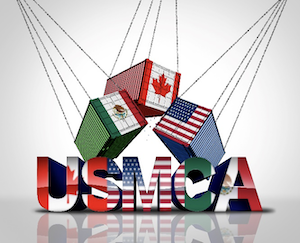
This is the first of a three-part series about the USMCA joint review process, focusing on China, Mexico, and competing visions of a “worker-centered” trade policy. Part one introduces the USMCA joint review process and explores how US trade policy would likely operate during Trump’s second term. Part two outlines some of the major trade issues that will be on the table during joint review, focusing on the Mexico-US relationship, and anticipates Harris’s likely approach to trade policy. Part three offers a critique of the worker-centered trade policy developed under the Biden administration, presents an alternative, and suggests new avenues for multi-stakeholder participation that Harris’s approach might create.

Read More »
arctic region

Coming Soon: A New Polar Icebreaker Competition in the Arctic Region for Trade Route Supremacy

The US, Canada, and Finland are launching a joint partnership to build more ice-breaking ships to compete with China and Russia in Arctic. Sad but true, here we go again. Whether it’s the South China sea, or even the moon, there will be territorial disputes to challenge ownership where no ownership should actually exist. The pact aims to produce a fleet of ice-breaking ships to display a posture of power in the polar regions and enforce international norms and treaties.

Read More »
a head scratcher

A Head Scratcher

A product has a country of origin of China, is not subject to China 301 duties and is eligible for USMCA benefits when imported from Canada – Whaaat!?

Read More »
Commercial International Trade Contracts

Using a Contract Review Checklist for Commercial International Trade Contracts

In the complex world of commercial international trade, contracts serve as the foundation for successful transactions. A well-prepared contract review checklist provides a basis for lawyers to ensure that all necessary terms and conditions are covered, protecting all parties involved. This article outlines the essential components of a contract review checklist related to goods in international trade. The goal is to provide a structured approach to reviewing and drafting contracts, beyond the basics of INCOTERMS.

Read More »
brics

BRICS – Shaping the Future of Global Finance and Investment

Imagine a world where five powerhouse nations are redefining the global economic landscape. BRICS—an acronym for Brazil, Russia, India, China, and South Africa—is not just a coalition of emerging markets; it is a formidable alliance shaping the future of global finance and investment. You can read about the coalition’s attempt to unseat the US dollar in our previous newsletter.

Read More »
texas

The Trade Powerhouse: Analyzing Texas’ Role in Global and National Trade

Texas isn’t just celebrated for its breathtaking landscapes and rich history—it’s a dynamic powerhouse in international and interstate trade. As the second-largest state in the U.S., Texas capitalizes on its strategic location, diverse economy, and vast infrastructure to fuel an extraordinary flow of goods and services. If Texas was a country, it would be ranked as the eighth- largest economy in the world, ahead of both Canada and Russia.

Read More »
steel and aluminum

New Presidential Proclamations – Section 232 Duties on Certain Steel and Aluminum Products from Mexico

On July 10, 2024, the President issued two Presidential Proclamations related to the imposition of Section 232 duties on certain steel and aluminum products from Mexico. The first establishes a “melt and pour” requirement for imports of steel articles that are products of Mexico and will increase the section 232 duty rate for imports of steel articles and derivative steel articles that are products of Mexico that are melted and poured in a country other than Mexico, Canada, or the United States.

Read More »
CTPAT security review

Navigating the Hurdles: Challenges of Conducting an Annual CTPAT Security Review

The Customs-Trade Partnership Against Terrorism (CTPAT) program can offer a fast thoroughfare for international trade. But navigating the annual security audits that ensure CTPAT compliance can feel like a maze. Don’t worry, we’ve got you covered! Let’s explore some common hurdles faced during CTPAT security audits, along with practical tips to simplify the process.

Read More »
judicial deference

Judicial Deference in Customs Litigation

One of the most anticipated decisions of the Supreme Court’s recent term was Loper Bright Enterprises v. Raimondo. While the specific underlying dispute in Loper Bright isn’t relevant to the trade community—did fishermen have to pay for government-mandated observers on their vessels?—the Court used this case to overturn the broadly applicable judicial deference test established in 1984 in Chevron U.S.A. Inc., v. Natural Resources Defense Council.

Read More »
Trade and Food Security

The Nexus of Trade and Food Security Amid Global Conflicts

The intricate interplay between trade and food security has emerged as a vital global issue, one that is closely interwoven with the tapestry of international conflicts and political instability. Remember the 2019 pandemic when toilet paper supply chains were interrupted?  Now imagine that on a much larger scale with basic food staples like rice, wheat or corn.

Read More »
CTPAT Supply Chain Hero of Trade

The Unsung Hero of Trade: Why CTPAT Matters

In the ever-changing world of trade, where predicting the future is a constant challenge, looking back at the past decade offers valuable insights into the evolution of the supply chain and the tools that have developed to contribute to efficiency and security.

Read More »
Voluntary Self-Disclosures

BIS Unveils Enhanced Voluntary Self Disclosure Protocols

On January 16, 2024, the Bureau of Industry and Security (BIS) under Assistant Secretary for Export Enforcement, Matthew Axelrod, disclosed significant enhancements to the process for Voluntary Self-Disclosures (VSDs) related to the Export Administration Regulations (EAR). These adjustments are strategically designed to streamline export control compliance for U.S. governmental bodies, the commercial sector, and academic entities.

Read More »
Importer Registration

Suspensión del Padron de Importadores

Uno de los requisitos más importantes para importar mercancías a México es estar registrado como importador en el registro de importadores mexicanos. Hay 2 tipos de registros para importadores, uno es para importadores generales (Padrón de Importadores) y el otro es para importadores de sectores industriales específicos (Padrón de Importadores de Sectores Específicos) que pueden importar mercancías identificadas por el código arancelario MX (es decir, productos químicos, armas de fuego, puros, calzado, textiles, alcohol, hidrocarburos, siderurgia, automoción, etc.). Generalmente, estos 2 registros son listados con información de personas y entidades autorizadas para importar mercancías a México.

Read More »
Importer Registration

Suspension of Mexican Importer Registration (Padron de Importadores)

One of the most important requirements for importing goods into Mexico is to be registered as an importer under the Mexican importer’s registry. There are 2 types of registries for importers, one is for general importers (Padron de Importadores), and the other is for importers of specific industry sectors (Padron the Importadores de Sectores Especificos) which may import goods identified by the MX tariff code (i.e. chemical products, firearms, cigars, footwear, textiles, alcohol, hydrocarbons, steel, automotive, etc.). Generally, these 2 registries are lists with information of individuals and entities authorized to bring goods into Mexico.

Read More »
free trade zone

Maximizing Duty Savings Series Leveraging Bonded Warehouse and Foreign Trade Zones

Consider this scenario: a client faced the challenge of deferring duty payments while managing a significant volume of imports destined for re-exportation from the U.S. Initially considering duty drawbacks, which proved unsuitable for their specific needs, we turned our attention to bonded warehouses and free trade zones. This scenario is not uncommon in the trade world and highlights a critical decision point for many businesses: choosing between a bonded warehouse and a Foreign Trade Zone (FTZ).

Read More »
first sale

What is the “First Sale” Rule and How Does it Affect Me?

The First Sale Rule applies in circumstances such as the example above. A US company places an order with a middleman in the US. The middleman in turn subcontracts to a foreign supplier. The supplier then ships the product either to the middleman or to the original US company that placed the order, meaning either could be the importer of record. The entered value could be the amount on the original purchase order or the price paid by the middleman to the foreign supplier.

Read More »
tolkenizing

Assessing the Benefits and Challenges of Tokenizing Real World Assets

The world of cryptocurrencies on blockchains and the world of traditional assets in markets have often stood in stark contrast to one another since Bitcoin’s creation in 2008. The lack of a reliable bridge between these two worlds has limited the impact of cryptocurrencies on assets in the real-world outside of on-chain speculation and prevented adoption of the benefits that blockchain technologies can bring to real world processes.

Read More »