CAPE Phase 3 Set for October 6 After Data-Validation Delay: What Importers Should Know
On February 20, 2026, the Supreme Court held that the International Emergency Economic Powers Act (IEEPA) does not authorize the President to impose tariffs. The Supreme Court did not itself order refunds; the U.S. Court of International Trade (CIT) did.
A Bad Actor, AI, and the Potential Creation of Global Trade Chaos and Armageddon

With the ever-growing barrage of rhetoric over just how, when, and if, AI will kill us all, the conversation also lends itself to, do we believe it will be AI that kills us, or a bad actor using AI?
CBP Asks for Comments On Supply Chain Compliance by 12/1/2026
CBP issued an Advance notice of proposed rulemaking, “Heightened Import Disclosures for Supply Chain Visibility,” 91 Fed Reg 56408 (FRN), on September 2, 2026. Responses are due to CBP by December 1, 2026, using the Federal eRulemaking Portal: http://www.regulations.gov. Follow the instructions for submitting comments via docket number USCBP–2026–1058.
U.S.-China “30-for-30” Tariff Lists Are Out, but Rates and Timing Are Not
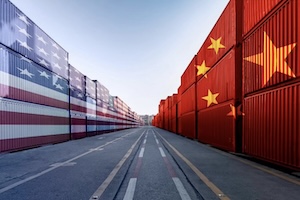
Chinese President Xi Jinping made a reciprocal state visit to Washington last week, meeting with President Donald Trump. The White House announced the new U.S.-China Board of Trade had reached a consensus on recommendations for more favorable tariff treatment on $30 billion of non-sensitive goods in each direction.
Lực Lượng Chống Gian Lận Thương Mại: Kỷ nguyên mới của việc siết chặt kiểm soát thương mại

Vào ngày 25 tháng 8 năm 2026, U.S. Department of Justice (DOJ) đã phối hợp với U.S. Department of Homeland Security (DHS) và U.S. Customs and Border Protection (CBP) để ra mắt Lực Lượng Chống Gian Lận Thương Mại (Trade Fraud Task Force). Lực lượng này đóng vai trò quan trọng trong chính sách siết chặt việc kiểm soát hành vi trốn thuế quan, gian lận hải quan và các hình thức buôn lậu theo Tariff Act of 1930, False Claims Act (FCA), cũng như các quy định về gian lận thương mại và âm mưu phạm tội thuộc Title 18.
Trade Fraud Task Force: A New Era of Trade Enforcement
On August 25, 2025, the U.S. Department of Justice (DOJ) launched the Trade Fraud Task Force (Task Force) in collaboration with the U.S. Department of Homeland Security (DHS) and the U.S. Customs and Border Protection (CBP). The cross-agency Task Force is a crucial part of the Administration’s enforcement agenda against tariff evasion, Customs fraud, and smuggling schemes under the Tariff Act of 1930, the False Claims Act (FCA), and Title 18’s trade fraud and conspiracy provisions.
CBP Can Now Void Importer of Record Numbers for Inaccurate Form 5106 Data
On September 18, 2026, U.S. Customs and Border Protection (CBP) began enhanced enforcement of importer of record (IOR) identity data on CBP Form 5106. CBP announced the enforcement program in a general notice published in the Federal Register. Accuracy of Importer of Record Data Submitted to CBP.
Duty Drawback and Commingled Returns: CBP Approves an Accounting Method Solution

Unused merchandise drawbacks allow a claimant to recover up to 99% of the duties paid on imported goods that are exported, unused, within five years of importation. For importers of apparel, footwear, eyewear, and accessories, customer returns complicate that recovery. Once a product has been sold at retail and is returned, United States Customs and Border Protection (CBP) treats it as merchandise that may have been used for its intended purpose, and its new appearance does not prove otherwise.
After the “Mess”: IEEPA Refunds and the Contractual Lessons for Businesses
As IEEPA refunds make their way back to importers, businesses are confronting a question that many commercial agreements never anticipated. Contracts frequently address who bears the cost when a new tariff is imposed, whether through a tariff surcharge, price-adjustment provision, or other pass-through mechanism. Far fewer address the opposite scenario: what happens when the tariff is later invalidated and the Importer of Record (“IOR”) receives the money back?
A New Era of Trade Fraud Enforcement
The new DHS/DOJ Trade Fraud Resource Guide should resonate across the trade ecosystem, especially for importers, Customs brokers, and in-house counsel.