
By Bob Brewer, Braumiller Law Group
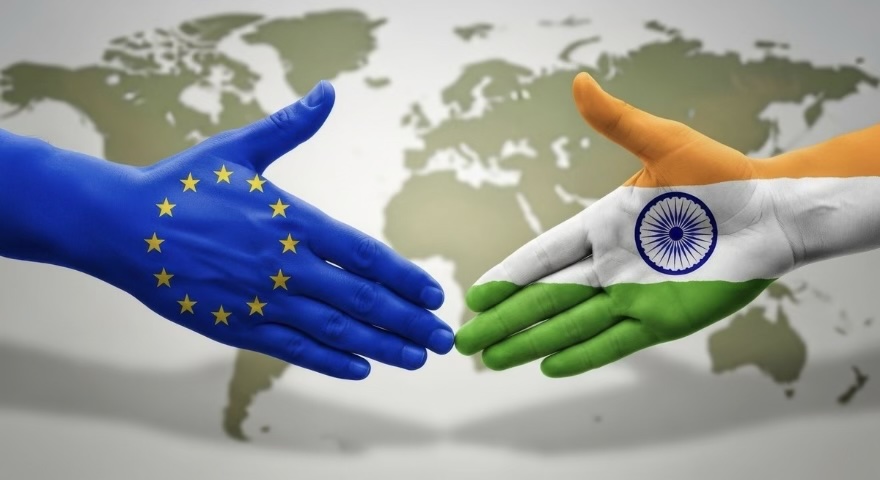
As of 1/27/2026, India and the EU have finalized a free trade agreement described by both sides as the “mother of all deals” that slashes tariffs, opens markets, and creates a combined economic region of roughly two billion people. This FTA stands as one of the most consequential global trade realignments in years, driven in part by U.S. tariff pressure and a shift in strategy toward diversifying one’s supply chains. It’s become the “way of the world” (Insert Earth, Wind & Fire tune here) in trade as uncertainty has steered more than a few countries to align themselves with trade partners that otherwise may never have been under consideration, much like China and Canada recently.
The settling of differences had been pushed far in the background of discussions for nearly two decades and the recent breakthrough created an economic zone representing 25% of global GDP and an estimated 33% of global trade. 33%!!!! It’s designed to deepen economic, strategic, and security cooperation beyond trade alone. These two countries by no means are strangers to each other’s trade offerings as a reasonable data‑grounded estimate shows that for India–EU total trade in calendar year 2025 was approximately $€190–195 billion, based on observed 2024 levels and verified 2025 monthly growth patterns in India’s export sectors. This estimate reflects stable goods flow, strong services growth, and broad‑based export resilience across Europe. India’s exports to the EU in 2024-2025 were primarily in petroleum products, textiles, leather, gems & jewelry, machinery, chemicals. EU’s exports to India were in goods covering categories like machinery, transport equipment, chemicals, pharmaceuticals, and high-tech goods. The fact remains that for 20 years these two countries could have been doing a lot better collectively if they had just agreed to disagree on a few things, rolled back some punishing tariffs, and opened their markets to each other even on an experimental basis.
So, what were the obstacles? Several longstanding issues repeatedly stalled India–EU trade negotiations for the twenty-year period mainly centered on of course tariffs, but also market access, regulatory standards, and intellectual property. These points of contention also explain why talks launched in 2007 collapsed in 2013 and only revived in 2022 when geopolitical pressures forced both sides back to the table only to stall again, and then, viola, enter the tariffs launched around the world by President Donald Trump, and the uncertainty that goes with it. The writing was on the wall to put their differences aside as the largest economy in the world was no longer so reliable in terms of a trade partnership. Neither country was fully to blame as the high tariffs were put in place on both sides, however India was a little bit more brutal tariff-to-tariff. India’s tariffs on EU goods, especially automobiles, wines, spirits, and certain agricultural products were among the biggest dealbreakers. These were explicitly cited as “mutually sensitive” issues that blocked progress. EU tariffs on Indian textiles, leather, footwear, and jewelry were also contentious, as India wanted deeper cuts to boost labor-intensive exports. There were also market access and regulatory barriers to overcome. The EU pushed for greater access to India’s markets in automobiles, agriculture, and high-value manufacturing, while India sought easier access for services, IT, and skilled labor mobility. Negotiations stalled in 2013 over disagreements on market access, government procurement, environmental clauses, data protection rules, and labor standards. Intellectual property (IP) disputes were also at the forefront as the EU sought TRIPS-plus protections, such as patent term extensions and data exclusivity, which India resisted due to concerns about access to affordable medicines. Public health groups warned that stronger IP rules could undermine India’s role as a global supplier of low-cost generics. Regarding agriculture and food standards, the EU insisted on strict sanitary and phytosanitary standards, while India viewed some of these as non-tariff barriers. Sensitive EU agricultural sectors (beef, poultry, sugar, rice) were excluded from liberalization, limiting India’s export ambitions. They also had roadblocks with sustainability and data governance and digital trade. For years, neither country prioritized the relationship, leading to far less than stellar trade ties. To be more specific India placed a 110% tariff on vehicles above $40,000 and 70% for cars below $40,000, which was absolutely brutal. This of course was a major sticking point as these tariffs were among the highest car import duties in the world. In addition, India slapped a 150% tariff on wine, 150% on sprits, and 110% on beer turning these rather simple pleasures into luxuries. Chocolate, biscuits, pasta, bread, pastries, pet food were slapped with a 50% tariff, vegetable oils & related products like olive oil, margarine, other vegetable oils received a 45% tariff, fruit juices & nonalcoholic beer, up to 55%, meat & animal products such as sausages & meat preparations, up to 110%, industrial goods machinery & electrical equipment, up to 44%, chemicals up to 22%, pharmaceuticals, 11%, optical, medical & surgical equipment 27%, and iron & steel Up to 22%. I could go on and on, but you get the point, and all of these tariffs were far higher than the EU tariffs on Indian goods. Honestly, one might think that these tariffs painted a rather dismal picture for any future trade negotiation to conclude in a mutually beneficial agreement, but here we are.
What’s changed? India agreed to reduce or eliminate tariffs on 96.6% of EU exports, while the EU will phase in reductions covering nearly 99% of India’s exports by value. On EU originating cars tariffs drop from up to 110% as previously mentioned to 10%!!!!!!, under a quota of 250,000 vehicles per year. European wine, spirits, chocolates, olive oil, and processed foods will see major duty cuts or elimination. Regarding EU chemicals, machinery, aerospace products the tariffs are largely eliminated. Indian exports such as textiles, leather, gems, jewelry, engineering goods gain near-zero-tariff access to the EU. Sounds like China’s playbook here with zero tariffs. Regarding regulatory and market access they simplified Customs procedures to speed up trade flows where a separate mobility pact eases movement for skilled Indian workers and students into Europe. A framework for defense and security cooperation accompanies the trade deal as well since the EU doesn’t feel as comfortable these days considering the current NATO relationship with the U.S.
This agreement is expected to cut €4 billion annually in tariffs for exporters therefore EU exports to India are projected to double by 2032. It also supports and potentially expands 800,000+ EU jobs tied to exports to India and strengthens supply chain integration and joint manufacturing capacity.
It goes without saying, but I will say it again anyway, U.S. tariffs under President Trump accelerated negotiations, pushing India and the EU to hedge against trade unpredictability. Obviously, both sides see the deal as a stabilizing force amid global trade fragmentation.
For India, it diversifies export markets away from U.S. exposure and boosts manufacturing competitiveness. For the EU, it opens one of the world’s fastest-growing consumer markets and strengthens strategic ties in the Indo-Pacific. Kudos to these two countries finally coming together for the sake of greatly enhanced trade and a subsequent boost to their economies going forward.